Cold Resistant
Conveyor Belt
For Extreme Winter Conditions
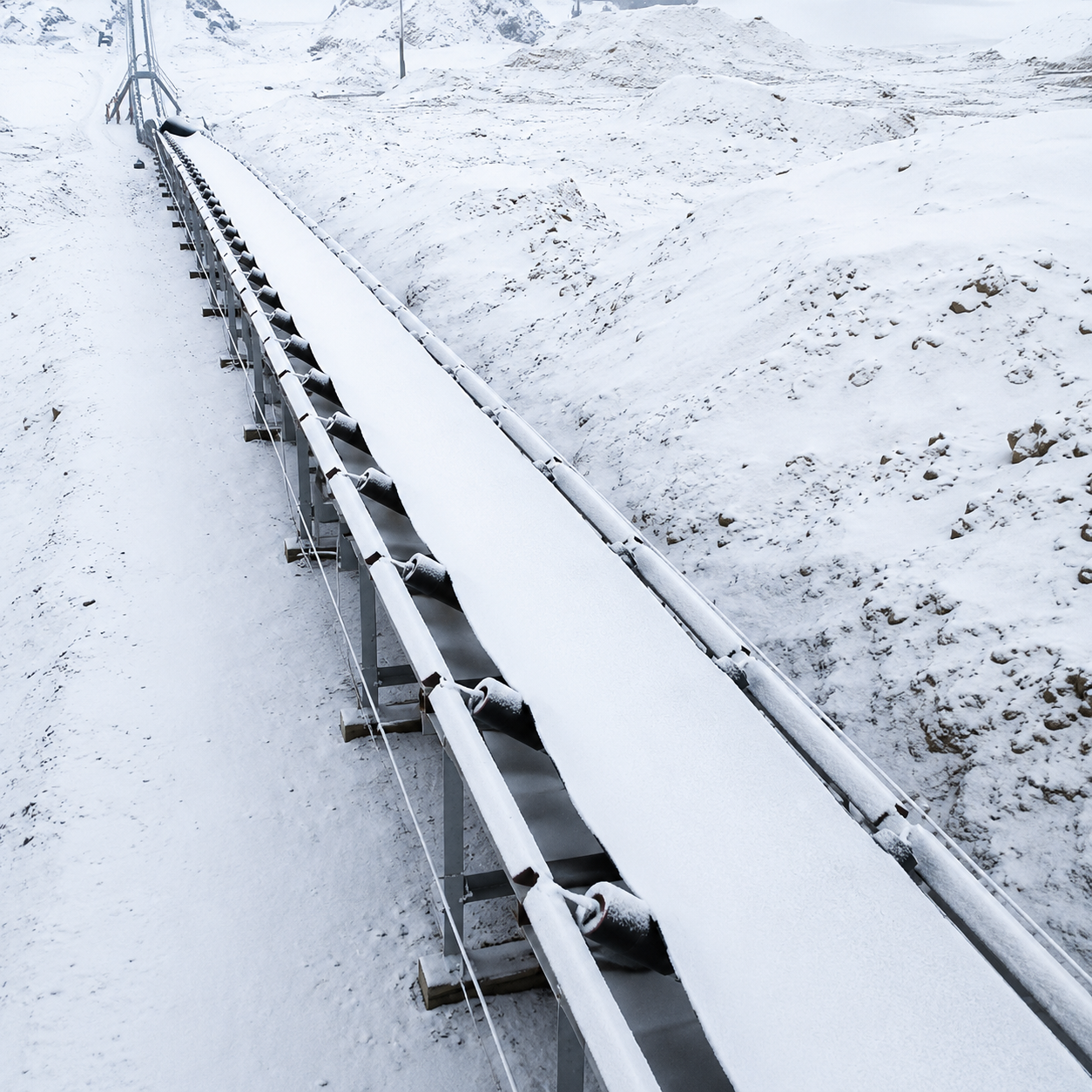
Stable conveying performance in temperatures down to -60°C — engineered for mining, ports, cement and bulk material handling industries where winter shutdowns are not an option.
How to Choose the Right Cold Resistant Belt
Two standard cold-resistance grades — C1 and C2 — cover the full range of winter industrial environments. Match your minimum site temperature to the right grade before specifying a belt.
Suitable for environmental temperatures from -45°C to +50°C. The preferred choice for most northern industrial operations, offering a cost-effective balance of cold resistance and service life.
Coefficient (DIN 22102)
- Good flexibility retained at -45°C
- Cost-effective for standard winter climates
- Available in NN and EP carcass types
- Recommended for: Northern China, Mongolia, Central Asia, Northern Europe
Suitable for environmental temperatures from -60°C to +50°C. Engineered for the world's harshest cold environments where C1 grade performance is insufficient.
Coefficient (DIN 22102)
- Superior crack resistance below -45°C
- Better flexibility at ultra-low temperatures
- Designed for severe cold environments
- Recommended for: Russia, Kazakhstan, Canada, Alaska, Siberia
| Test Item | Carcass Type: NN & EP | Minimum Value | |
|---|---|---|---|
| Cover Rubber & Ply | Cover thickness > 1.5 mm | 4.5 N/mm | ≥ 4.5 N/mm |
| Cover thickness ≤ 1.5 mm | 4.0 N/mm | ≥ 4.0 N/mm | |
| Ply and Ply | Between fabric layers | 5.0 N/mm | ≥ 5.0 N/mm |
| Property | Req. | Grade Y | Grade W | Grade X | |
|---|---|---|---|---|---|
| Cover Rubber Physical Property |
Tensile Strength (MPa) | ≥ | 20 | 18 | 25 |
| Elongation at Break (%) | ≥ | 400 | 400 | 450 | |
| Abrasion Loss (mm³) | ≤ | 150 | 90 | 120 | |
| Aging Test (70°C × 168 h) | — | Not change by more than 25% from original value | |||
| Tensile Cold Resistance Coefficient ≤ |
C1: −45°C (Env. temp. −45°C ~ +50°C) | ≤ | 0.3 | ||
| C2: −60°C (Env. temp. −60°C ~ +50°C) | ≤ | 0.2 | |||
| Reference Standard: DIN 22102 · HG/T 3647-1999 · Carcass: NN (Nylon/Nylon) & EP (Polyester/Nylon) | |||||
Not sure which grade is right for your site? Send us your minimum operating temperature and material type — we'll specify the correct belt in 24 hours.
Why Our Cold Belts
Outperform the Rest
A cold-resistant belt is only as good as the materials behind it and the process that builds it. Here's what makes JOYTRANS different — in raw numbers and real engineering.
Our cold-resistant compound blends natural rubber with special low-temperature polymers, maintaining an elongation at break of ≥ 400% even at -60°C — three times more flexible than standard belts at the same temperature.
Our 2.4-meter flat vulcanizing press machines apply precisely controlled temperature and pressure throughout the cure cycle. Consistent cross-linking density is what gives the belt its stable cold-weather properties — press by press, batch by batch.
Ply-to-ply adhesion of ≥ 5 N/mm, and cover-to-ply adhesion of ≥ 4.5 N/mm — values measured at cold temperatures. This ensures the carcass stays unified even when thermal contraction tries to pull the layers apart.
Our R&D center's high-low temperature strength testing machine validates every compound batch at the target operating temperature. No simulation — we test the actual belt in the actual temperature range before it leaves the factory.
Every cold-resistant belt is manufactured and tested to DIN 22102 and HG/T 3647-1999. The standard defines minimum tensile strength, elongation, abrasion loss and the tensile cold resistance coefficient that grades C1 and C2 must meet — no exceptions.
No middlemen, no traders. You deal directly with the manufacturer. That means complete transparency on raw material specs, the ability to audit our production, and lead times that only a factory can offer — not a trading company.
Want to see our process in detail? Request our factory audit report or schedule a factory visit.
Built in Our
Own Factory
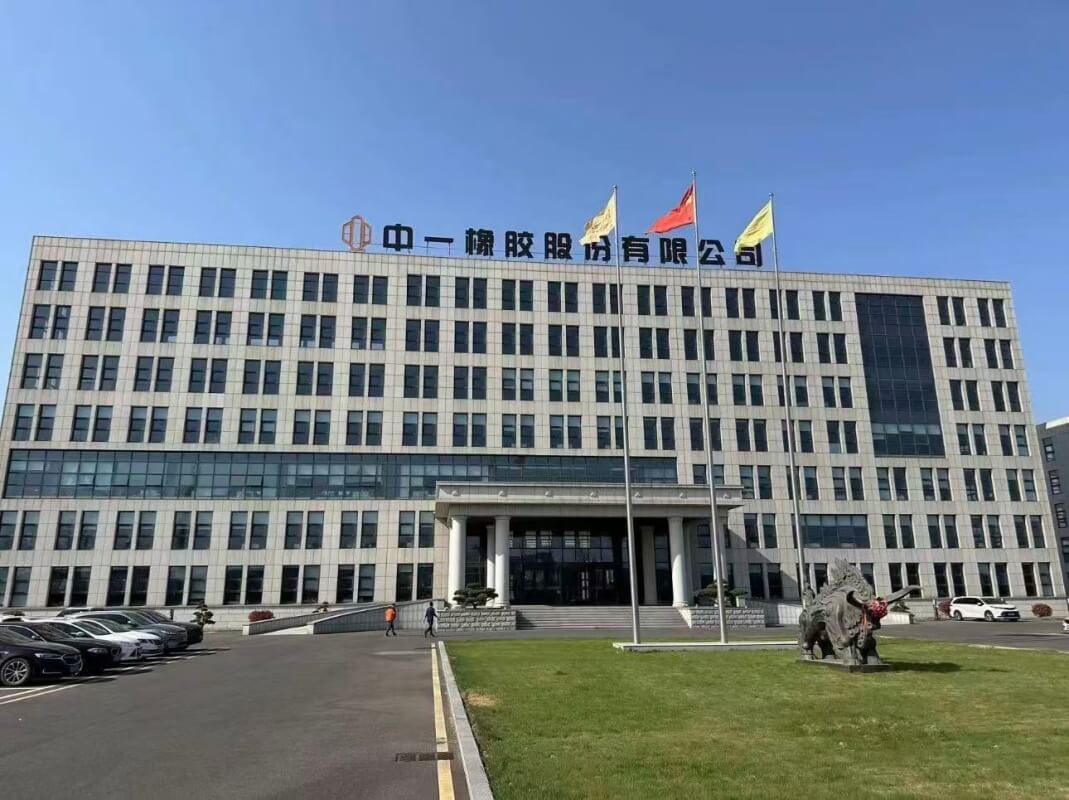
Zhongyi Rubber Co., Ltd. — founded 2004, Guangrao County, Shandong. Every cold-resistant belt is manufactured, tested and shipped directly from our own production facility. No trading. No outsourcing.
Manufacturing
Certified
Delivered
Proven in the
World's Coldest Operations
Real projects. Real temperatures. Real results — from customers who couldn't afford winter downtime.
Stable operation throughout the winter season with no surface cracking, no splice failure and no unplanned production stops recorded during the coldest months.
C2-grade belt maintained full flexibility and grip in extreme Arctic conditions. No cracking or surface deterioration recorded across two consecutive winter seasons.
Belt handled high-impact loading from frozen ore lumps without cover delamination. 3-year service life achieved — 40% longer than the previous supplier's belt under identical conditions.
Operating in similar conditions? Tell us your site details and we'll prepare a belt specification matched to your project.
20 Years of Belt Manufacturing
Behind Every Delivery
JOYTRANS (Zhongyi Rubber Co., Ltd.) was established in 2004 in Guangrao County, Shandong — China's leading rubber production region. Here is the infrastructure behind our cold-resistant belts.
(ISO 9001 · ISO 14001 · OHSAS)
Registered
Outlets
Completed
-
2.4m Flat Vulcanizing Press MachinePrecision cure control — temperature, pressure and time logged per run
-
Double Layer Vulcanizing Press MachineSimultaneous dual-layer curing for improved productivity
-
XY-4s-2500 Four-Roll Calender MachineHigh-precision compound calendering onto NN/EP fabric
-
XY-4s-1830 Four-Roll Calender MachineSecondary calender line for smaller-width belt production
-
Constant Tension Forming MachineUniform carcass tension throughout belt building
-
2.4m Roto-Curing MachineContinuous curing for long-length textile conveyor belts
-
Chevron Curing MachineDedicated press for chevron-pattern surface belt production
-
High-Low Temperature Strength Testing MachineValidates cold resistance coefficient at operating temperature range
-
AI-7000W-LAU10 Servo Universal Testing MachineAdhesion, tensile strength and elongation measurements at temperature
-
Flexibility & Troughability Testing MachineConfirms belt conforms correctly to troughing idlers at low temperature
-
Abrasion TesterDIN abrasion loss measured per cover grade batch
-
Mooney Viscosity TesterRaw compound consistency check before every production run
-
Rotorless Vulcanizer (Rheometer)Cure curve analysis for optimal vulcanization parameters
-
Drum Friction & Steel Cord Strength TestersFull mechanical testing for steel cord and textile carcass products
Why Standard Belts
Fail in Winter
Below -20°C, conventional rubber compounds lose elasticity and become rigid. The result is cracking, slipping and unplanned downtime — exactly when your operation can least afford it.
What Goes Wrong
Common failure modes of standard conveyor belts in sub-zero environments
-
Rubber Hardening
Standard compounds lose elasticity at low temperatures, turning rigid and brittle — a direct path to breakage under load.
-
Surface Cracking
Thermal contraction opens micro-fissures in the cover rubber, allowing moisture ingress and accelerating deterioration.
-
Reduced Flexibility
A stiff belt cannot conform to idlers and pulleys, creating edge stress and premature structural fatigue.
-
Belt Slipping
Ice formation and reduced surface friction cause the belt to slip on drive pulleys, stalling entire conveying lines.
-
Splice Failure
Cold weakens standard adhesive bonds at joints. Delamination is the number-one cause of cold-weather belt failure.
-
Unexpected Downtime
Every unplanned stop in winter costs thousands per hour — and replacement logistics in remote cold sites multiply that further.
Our Engineering Answer
Purpose-built solutions maintaining full performance from -45°C down to -60°C
-
Flexible Rubber Compound
Proprietary low-temperature formula retains full elasticity at -60°C — the belt bends, the operation continues.
-
Cold-Resistant Cover Rubber
Specially formulated cover grades maintain surface integrity through freeze-thaw cycles, eliminating cracking.
-
High-Adhesion Fabric Layers
Multi-ply textile carcass with cold-cure adhesion maintains structural integrity across the full temperature range.
-
Stable Impact Resistance
Reinforced impact zones absorb frozen-material shock — ore, coal, aggregate — without cover delamination.
-
Reliable at -45°C / -60°C
Engineered splice systems using cold-resistant adhesives ensure joint integrity even in extreme sub-zero conditions.
-
Extended Service Life
Proven in Arctic mining and Siberian port terminals — delivering full-season performance and lower total cost of ownership.
Cold Resistant Belt
Technical Q&A
Everything buyers, engineers and procurement teams ask before specifying a cold-resistant conveyor belt — answered directly.
Our cold resistant conveyor belts are available in two grades for different low-temperature environments:
- C1 Grade: suitable for temperatures down to -45°C (environmental range: -45°C to +50°C)
- C2 Grade: suitable for extreme environments down to -60°C (environmental range: -60°C to +50°C)
The exact working temperature also depends on the cover rubber compound selected, the conveyed material, operating conditions, belt speed, and loading conditions. For extremely cold regions such as Russia, Kazakhstan, Canada, and Mongolia, C2 grade is generally recommended.
The main difference is the low-temperature resistance performance, defined by the tensile cold resistance coefficient:
| Grade | Working Temperature | Cold Resistance Coefficient | Application |
|---|---|---|---|
| C1 | Down to -45°C | ≤ 0.3 | Standard winter & cold regions |
| C2 | Down to -60°C | ≤ 0.2 | Arctic & extreme cold environments |
- Good flexibility and cost-effective
- Suitable for general winter conditions
- Available in NN and EP carcass
- Superior crack resistance
- Better flexibility at ultra-low temperatures
- Designed for severe cold environments
If your conveyor system operates continuously in temperatures below -45°C, C2 is the recommended option.
Yes — we can manufacture cold resistant and oil resistant conveyor belts simultaneously. For applications involving petroleum coke, oily coal, chemical materials, fertilizer, wood chips, or recycled materials, we recommend a Cold Resistant + Oil Resistant (MOR) rubber compound combination. This ensures low-temperature flexibility, resistance to oil swelling, longer service life, and stable operation in winter conditions. Customized compound formulas are available based on your material type and operating environment.
| Feature | EP Carcass (Polyester/Nylon) | NN Carcass (Nylon/Nylon) |
|---|---|---|
| Elongation | Lower — better dimensional stability | Higher |
| Tensile Strength | Higher | Moderate |
| Flexibility | Good | Excellent |
| Troughability | Good | Better |
| Impact Resistance | Good | Higher |
For most modern industrial applications — including mining, ports, and heavy-duty bulk handling — EP carcass is the preferred choice because of its stability, lower elongation and better performance on long-distance conveying systems. NN carcass is recommended for short-distance, high-impact loading points or systems requiring maximum flexibility.
Service life depends on material type, operating temperature, conveyor design, maintenance, loading impact and pulley diameter. Under normal operating conditions, our cold resistant conveyor belts typically achieve 3–5 years in standard heavy-duty applications, with longer service life achievable through proper maintenance and correct grade selection. Using the correct belt grade for the environment — C1 vs C2 — is the single most important factor in maximising belt longevity.
- Store indoors whenever possible; keep away from direct sunlight
- Avoid contact with oil, chemicals, and moisture
- Storage temperature should ideally remain above 0°C
- Avoid excessive bending or compression during storage
- Keep belts away from heaters and open flames
Before installation in extremely cold weather, keep the belt at a moderate temperature for several hours and avoid sudden heavy loading during startup.
Yes — we provide full OEM and customized branding services. Available options include custom logo printing, customized belt markings, packaging customization, private label production, and customized datasheets and catalogues. We can also manufacture according to your technical specifications, market standards, and special compound requirements.
Our conveyor belts can be manufactured according to international standards including DIN 22102, ISO standards, RMA standards, AS standards, JIS standards, and GB/T standards. For cold resistant conveyor belts, the primary standard is DIN 22102. We can also produce belts according to customized technical requirements and project specifications.