General Use
Textile Conveyor Belt
The proven medium-duty solution for mining, cement, ports, and bulk material handling — where reliable belt performance meets smart procurement economics.
What Is a
Textile Belt?
Textile conveyor belts use a multi-ply woven fabric carcass — NN (nylon-nylon) or EP (polyester-nylon) — vulcanized between rubber cover layers. Each component is specified independently, so the belt is precisely matched to your conveyor's load, speed, and environment — without the cost premium of steel cord.
Select Your Belt Type
Three carcass constructions, each matched to a specific range of loads, distances, and operating conditions. Pick the one that fits your conveyor system exactly.
Unsure which carcass type fits your conveyor? Our engineers review your load, speed, and distance requirements and recommend the right specification — at no cost.
Get a Free Belt RecommendationBelt Structure
Every layer has a job. Understanding the three-part construction helps you specify the right compound, ply count, and thickness for your exact application.
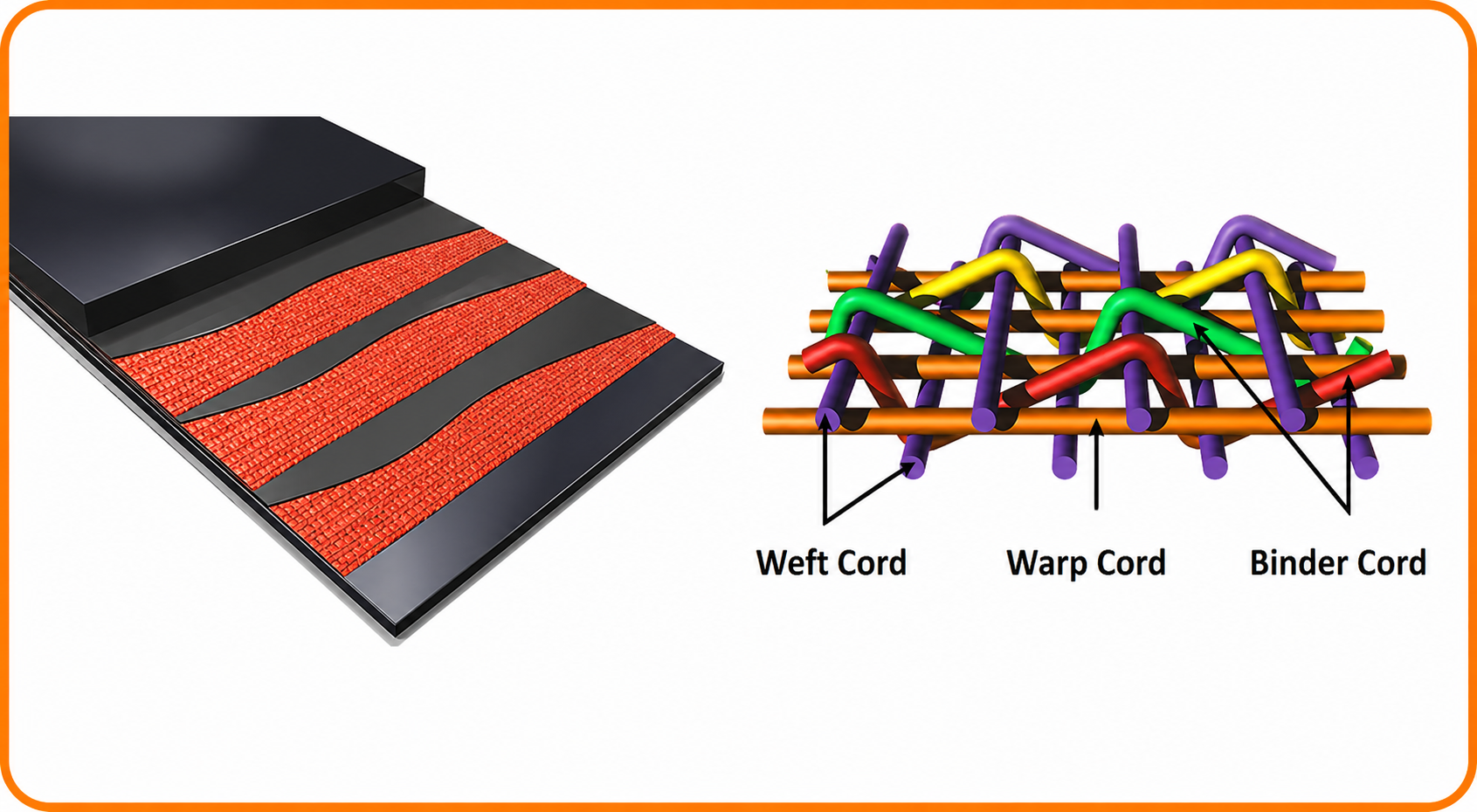
Every belt ships with a complete technical drawing — cover compound, carcass rating, width, and length confirmed before production. Get yours with your quote.
Technical Specifications
Full EP fabric carcass parameters and multi-ply tensile grades — matched to every major international standard. Download the complete datasheet for your region's compliance requirements.
| Test Item | EP100 | EP150 | EP200 | EP250 | EP300 | EP350 | EP500 | |||||||
|---|---|---|---|---|---|---|---|---|---|---|---|---|---|---|
| Warp | Weft | Warp | Weft | Warp | Weft | Warp | Weft | Warp | Weft | Warp | Weft | Warp | Weft | |
| Breaking Strength (N/mm) | ≥100 | ≥55 | ≥150 | ≥75 | ≥200 | ≥78 | ≥250 | ≥80 | ≥300 | ≥80 | ≥350 | ≥75 | ≥500 | ≥105 |
| Breaking Elongation (%) | ≥14.0 | ≤45.0 | ≥14.0 | ≤45.0 | ≥14.0 | ≤45.0 | ≥14.0 | ≤45.0 | ≥14.0 | ≤45.0 | ≥14.0 | ≤45.0 | ≥14.0 | ≤45.0 |
| Elongation at 10% Load (%) | ≤1.5 | ≤1.5 | ≤1.5 | ≤1.5 | ≤1.5 | ≤1.5 | ≤2.0 | |||||||
| Heat Shrinkage 150°C/30min (%) | ≤5.0 | ≤1.0 | ≤5.0 | ≤1.0 | ≤5.0 | ≤1.0 | ≤6.0 | ≤1.0 | ≤6.0 | ≤1.0 | ≤6.0 | ≤1.0 | ≤6.0 | ≤1.0 |
| Adhesion (N/2.5cm) | ≥196.0 | ≥196.0 | ≥196.0 | ≥196.0 | ≥196.0 | ≥196.0 | ≥196.0 | |||||||
| Weight (G/m²) | 370±30 | 520±30 | 610±40 | 780±40 | 860±40 | 980±40 | 1320±50 | |||||||
| Thickness (mm) | 0.53±0.06 | 0.70±0.06 | 0.85±0.09 | 1.00±0.10 | 1.15±0.10 | 1.20±0.10 | 1.70±0.14 | |||||||
| Fabric / Ply | 3P | 4P | 5P | 6P | ||||
|---|---|---|---|---|---|---|---|---|
| kg/cm | lb/in | kg/cm | lb/in | kg/cm | lb/in | kg/cm | lb/in | |
| EP-100 | 300 | 1680 | 400 | 2240 | 500 | 2800 | 600 | 3360 |
| EP-125 | 375 | 2100 | 500 | 2800 | 625 | 3500 | 750 | 4200 |
| EP-150 | 450 | 2520 | 600 | 3360 | 750 | 4200 | 900 | 5040 |
| EP-200 | 600 | 3360 | 800 | 4480 | 1000 | 5600 | 1200 | 6720 |
| EP-250 | 750 | 4200 | 1000 | 5600 | 1250 | 7000 | 1500 | 8400 |
| EP-300 | 900 | 5040 | 1200 | 6720 | 1500 | 8400 | 1800 | 10080 |
| EP-350 | 1050 | 5880 | 1400 | 7840 | 1750 | 9800 | 2100 | 11760 |
| Cover Grade | Country | Applicable Standards | Min. Tensile Strength (MPa) | Min. Elongation at Break (%) | Max. Abrasion Loss (mm³) |
|---|---|---|---|---|---|
| Germany — DIN22102 | |||||
| DIN-Z | Germany | DIN22102 | 15 | 350 | 250 |
| DIN-Y | Germany | DIN22102 | 20 | 400 | 150 |
| DIN-X | Germany | DIN22102 | 25 | 450 | 120 |
| DIN-W | Germany | DIN22102 | 18 | 400 | 90 |
| U.S.A — RMA / ARPM | |||||
| RMA-I | U.S.A | RMA | 17 | 400 | 150 |
| RMA-II | U.S.A | RMA | 14 | 400 | 200 |
| ARPM RMA-I | U.S.A | ARPM | 17 | 400 | 125 |
| ARPM RMA-II | U.S.A | ARPM | 14 | 400 | 175 |
| International — ISO-10247 | |||||
| ISO-L | International | ISO-10247 | 15 | 350 | 200 |
| ISO-H | International | ISO-10247 | 24 | 450 | 120 |
| ISO-D | International | ISO-10247 | 18 | 400 | 100 |
| Australia — AS-1332 | |||||
| AS-N | Australian | AS-1332 | 17 | 400 | 200 |
| AS-M | Australian | AS-1332 | 24 | 450 | 125 |
| AS-A | Australian | AS-1332 | 17 | 400 | 70 |
| South Africa — SANS-1173 | |||||
| SANS-N | South Africa | SANS-1173 | 17 | 400 | 150 |
| SANS-M | South Africa | SANS-1173 | 25 | 450 | 120 |
| SANS-A | South Africa | SANS-1173 | 18 | 400 | 70 |
| United Kingdom — BS-490 | |||||
| BS-M | UK | BS-490 | 24 | 450 | 120 |
| BS-N | UK | BS-490 | 17 | 400 | 200 |
| India — IS 1891 | |||||
| IS-N-17 | India | IS 1891 | 17 | 400 | 200 |
| IS-M-24 | India | IS 1891 | 24 | 450 | 150 |
| Japan — JIS-K 6332 | |||||
| JIS-G | Japan | JIS-K 6332 | 14 | 400 | 250 |
| JIS-L | Japan | JIS-K 6332 | 15 | 350 | 200 |
| JIS-D | Japan | JIS-K 6332 | 18 | 400 | 100 |
| JIS-H | Japan | JIS-K 6332 | 24 | 450 | 120 |
| China — GB/T 7984 | |||||
| GB-H | China | GB/T 7984 | 24 | 450 | 120 |
| GB-D | China | GB/T 7984 | 18 | 400 | 100 |
| GB-L | China | GB/T 7984 | 15 | 350 | 200 |
Need the full technical datasheet for your procurement or engineering team? Download it or request a specification quote for your exact application.
Where Our Belts Perform
General use textile conveyor belts deliver reliable bulk material handling across four core industries — wherever medium-duty, cost-efficient conveying matters.
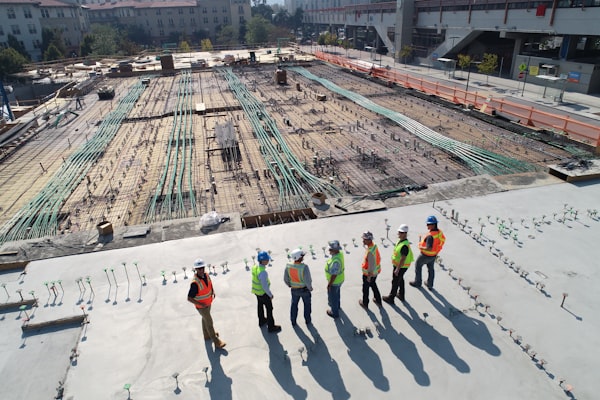

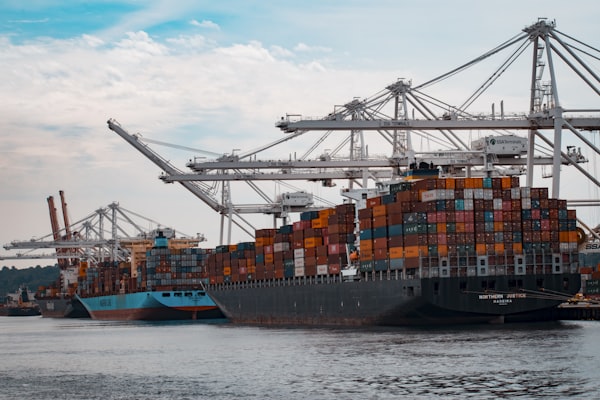

Tell us your industry, material, and conveyor dimensions — we'll recommend the right belt grade and specification for your operation.
Get an Application-Specific QuoteTextile vs Steel Cord
Not every conveyor needs steel cord. Understanding the trade-offs upfront means you select the right belt the first time — and avoid paying for performance you don't need.
Our engineers compare textile and steel cord options for your specific application — and recommend the belt that delivers the best total cost of ownership.
Get a Free Belt Selection ConsultationFactory-Direct Supply
No intermediaries. Factory-direct supply with stable quality, competitive pricing, and an engineering team ready to specify the right belt for your application — from day one.

Tell us your conveyor specification and destination country. We'll confirm price, lead time, and logistics within 24 hours.